


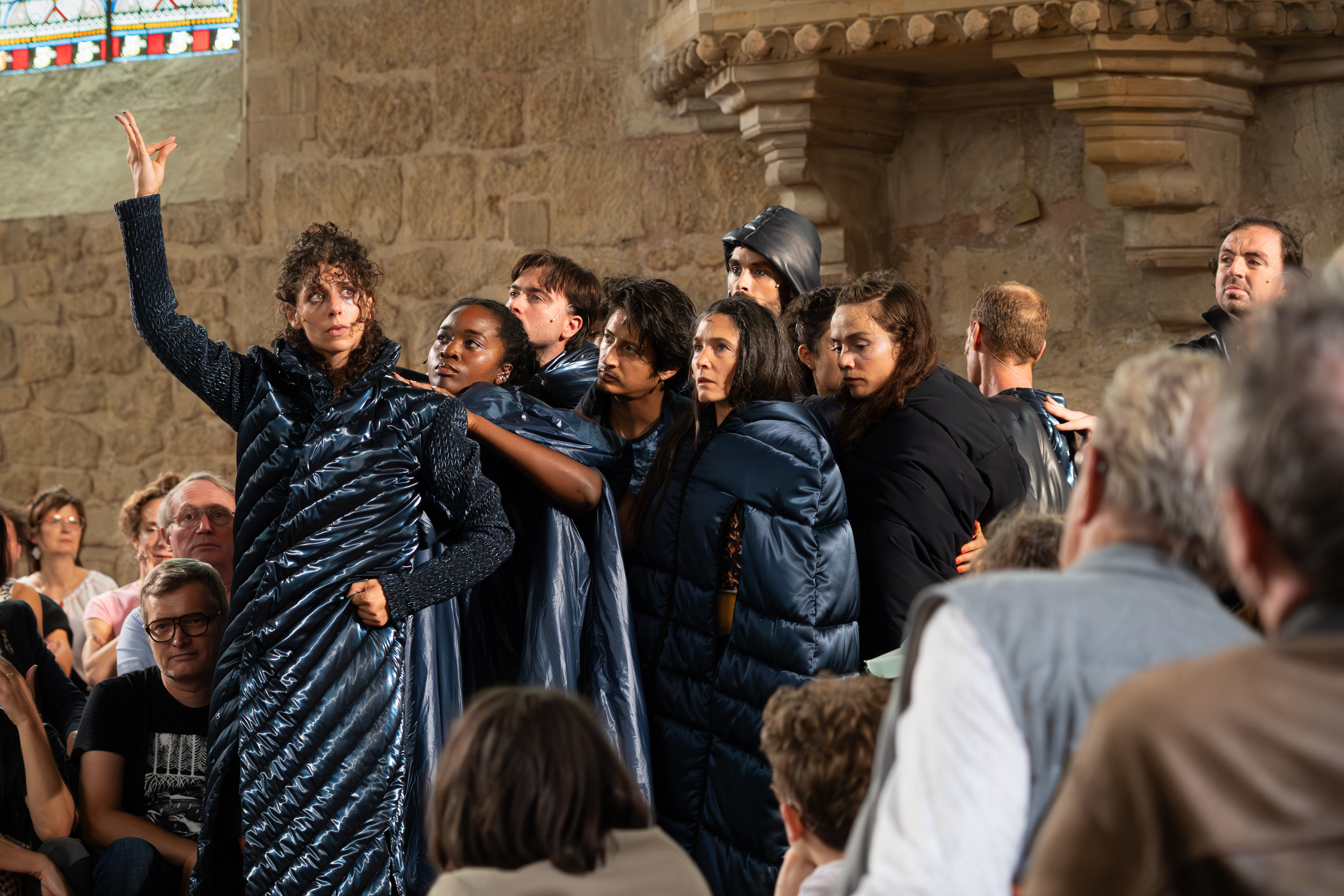
In absentia offers an unprecedented situation : to infiltrate the heart of a group of artists, singers and dancers, and experience the fabrication of polyphony and collective gesture. As closely as possible to the performers and their gestures, the audience, seated in concentric circles, becomes the witness and the source of a continuous movement that surrounds and crosses them.
The thirteen performers, linked by a long shared practice, explore the repertoires of the Renaissance sacred music. Based on artworks related to the rites of the dead, In absentia reveals the dizzying architectures of these sonic representations of the afterlife and absence. Composed to reflect the harmony of the spheres and the movement of the constellations, these works unfold through the bodies of the thirteen performers, engaged in an uninterrupted movement and embodied in the form of medieval tresques, bas-reliefs and gruesome dances.
In absentia places the audience at the heart of a paradox: it is only through an utterly human effort that the illusion of an afterlife can arise. Immersed among the performers, the audience witnesses the entire manufacturing process of a polyphony, from gesture to unison, from slowness to frantic speed. All the strategies of listening, all the efforts, the breaths, the sweats, the micro-signals become one of the materials of this performance that experiences the real-time fabrication of the miraculous and the collective.